Introducing Celect and Cai
A More Thoughtful Way to Hire
Celect brings recruiting work into one connected system, while Cai helps teams organize candidate context, review application-integrity signals, and move hiring forward with people firmly in control.

Direct answer
Celect is an AI hiring platform built around Cai, a recruiting assistant that helps teams coordinate jobs, candidate review, communication, interviews, application-integrity signals, and reporting. Cai supports the work; recruiters and hiring teams remain responsible for reviewing context and making final employment decisions.
Recruiting did not become difficult because people forgot how to recognize good candidates. It became difficult because the work around that decision spread across too many places. A job description lives in one tool. Applications arrive in another. Interview notes are buried in calendars and inboxes. Someone is chasing feedback, someone else is updating a spreadsheet, and the recruiter is expected to hold the whole story together.
That fragmentation is the problem we built Celect to solve. Celect is a hiring platform built around Cai—pronounced “Kai”—an AI recruiting assistant designed to help a team move from an open role to a well-supported decision without losing the context between those steps.
The important word is help. Cai can organize information, prepare work, surface patterns, and keep a process moving. The recruiter and hiring team still decide what matters, question what looks wrong, speak with the candidate, and make the final call.
Why we built Celect
Most recruiting software is good at recording what happened. It stores a candidate, a stage, a message, or a score. But the work of recruiting is not just record keeping. It is a series of connected judgments: what the role actually needs, which evidence matters, who deserves a closer look, what question should be asked next, and where the process is getting stuck.
Teams often answer those questions by stitching together an applicant tracking system, email, calendars, spreadsheets, sourcing tools, and a growing stack of point solutions. Each tool may work on its own. The cost appears in the handoffs. Context gets copied, decisions get delayed, and candidates receive an experience shaped by whatever task is most urgent that day.
We wanted Celect to feel less like another database and more like an operating layer for hiring. The system should understand the role, keep the relevant candidate context close, and help the team complete the next piece of work. That might mean preparing a job post, organizing applications for review, drafting outreach, coordinating an interview, or explaining what changed in the pipeline.
Meet Cai, the intelligence layer inside Celect
Cai is not meant to be a chatbot bolted onto an applicant tracking system. It is the conversational and reasoning layer that works across the hiring process. A recruiter should be able to describe the outcome they need in ordinary language, review what Cai prepares, and stay in control of anything consequential.
In practice, that means Cai can support several kinds of work:
- Turn the hiring team’s requirements into a structured role and a clearer job post.
- Organize application information around job-relevant criteria so recruiters know where to focus.
- Prepare personalized candidate communication and reduce repetitive follow-up work.
- Coordinate interviews, pipeline movement, and the operational details that usually create delays.
- Summarize activity and surface patterns so a team can understand its hiring process without rebuilding the story by hand.
None of those tasks requires pretending that software knows a person better than the people meeting them. The value comes from reducing administrative drag and making the available evidence easier to inspect. A useful AI assistant should create room for better judgment, not hide judgment behind a score.
Application integrity is about better questions, not catching people out
Hiring teams are also dealing with a real information problem. Applications can be incomplete, copied, embellished, generated at scale, or simply inconsistent because a resume and an online profile were updated at different times. Treating every mismatch as fraud would be careless. Ignoring every mismatch would be careless too.
Celect’s application-integrity approach is designed to bring relevant signals together and show the recruiter where closer review may be useful. Depending on the information available, that review can include education and employment claims, professional profiles, technical portfolios, contact details, identity consistency, certifications, publications, or awards.
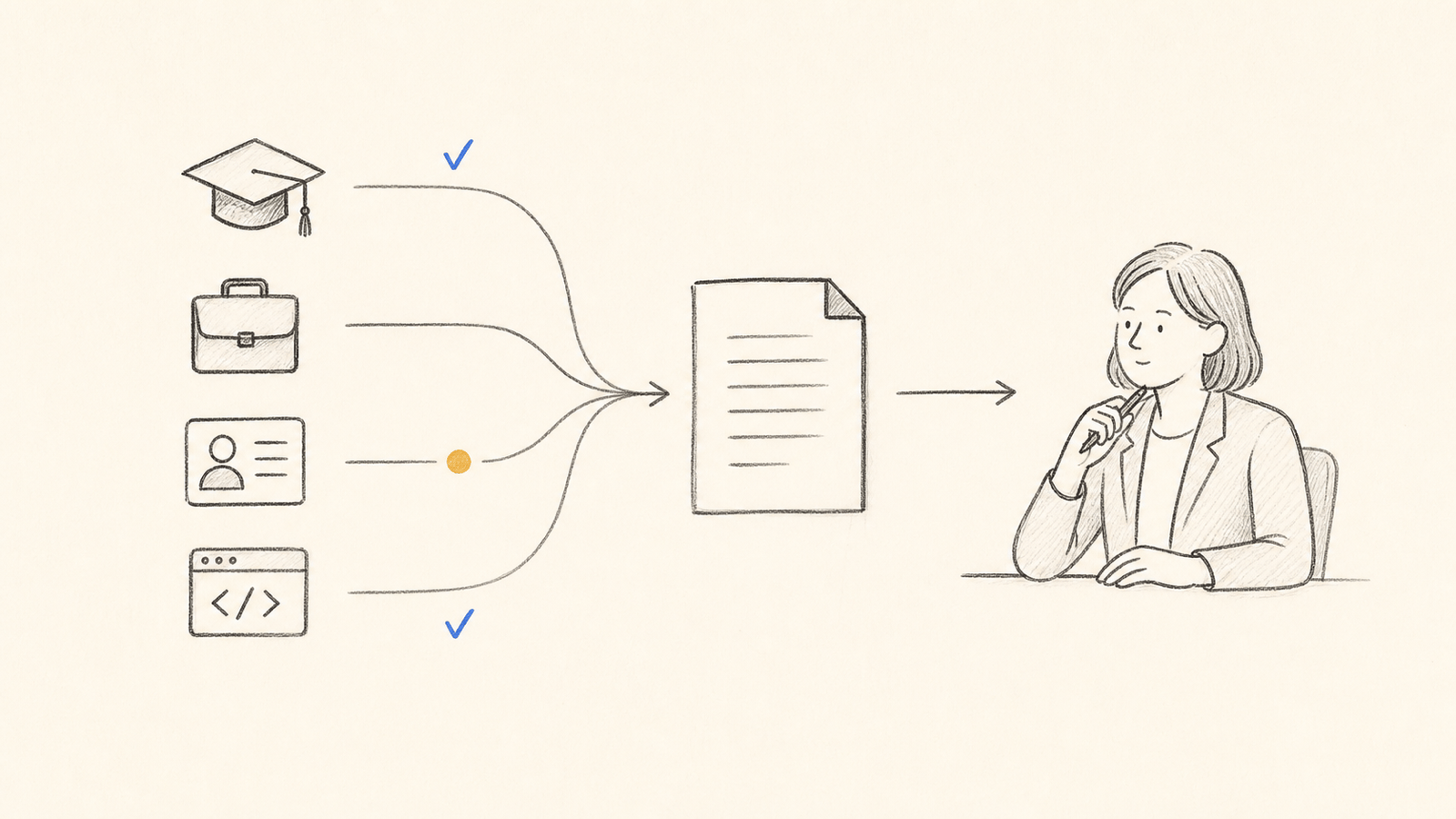
The goal is not to produce a dramatic red stamp. It is to separate different situations that are too often collapsed into one label. Some information is consistent with the available evidence. Some information cannot be verified from the sources at hand. Some information conflicts and needs a conversation. Those are meaningfully different outcomes.
An “unable to verify” result is not proof that a claim is false. A small company may have changed names. A school may not expose public records. A candidate may have used a preferred name, worked through an agency, or left an old profile untouched. Even a stronger inconsistency should be treated as a prompt to inspect the underlying evidence and ask a fair question—not as an automatic rejection.
What an application signal should—and should not—mean
A signal is useful only when the person reviewing it understands its limits. We think teams should use a simple discipline:
- Start with the source. What information produced the signal, and is that source appropriate for the claim being reviewed?
- Separate missing evidence from contradictory evidence. They are not the same thing.
- Look for a reasonable explanation before escalating a concern.
- Keep the review connected to the requirements of the role rather than collecting information because it is available.
- Record the human decision and the reason for it, especially when it differs from an automated suggestion.
That last step matters. If a system can influence attention but nobody can explain how its output was used, the team has not removed subjectivity; it has made subjectivity harder to see. Good recruiting technology should make the decision process easier to examine.
Human control is part of the product, not a disclaimer
Employment decisions carry consequences for candidates and employers. That is why human oversight cannot be reduced to a checkbox at the end of an automated process. The people using the system need enough context, authority, and time to challenge what it suggests.
The NIST AI Risk Management Framework makes a similar point: organizations should define the roles and responsibilities in a human–AI system, document how oversight works, and continue managing risk throughout the system’s life. Guidance from the U.S. Equal Employment Opportunity Commission also makes clear that employers remain responsible for how algorithmic tools affect applicants, including people with disabilities.
For a hiring team, responsible use is practical rather than abstract. Criteria should be job-related. Recruiters should be able to review the information behind a recommendation. Candidates should have a path to accommodations and appropriate clarification. Teams should monitor outcomes, and local rules may add audit or notice requirements for certain automated employment decision tools.
A connected workflow, from request to decision
The broader Celect workflow follows the same principle: let software carry coordination while people own judgment.
- Define the role. Capture the actual outcomes, constraints, and job-relevant criteria before applications arrive.
- Prepare the search. Turn that context into a job post, screening structure, and repeatable process.
- Review candidates in context. Organize applications around the role instead of ranking people by keywords alone.
- Inspect application-integrity signals. Distinguish consistent, unavailable, and conflicting information, then review the evidence.
- Move the process forward. Prepare communication, coordinate interviews, and keep the pipeline current with human approval where it matters.
- Learn from the process. Use recruiting analytics to understand delays, workload, and outcomes rather than relying on anecdotes.
A connected system does not remove every handoff. It makes the handoffs intentional. The recruiter can see what Cai prepared, the hiring manager can see what needs a decision, and the candidate is less likely to disappear into the gap between tools.
What Celect is not
Celect is not an automatic hiring authority. It is not a substitute for a recruiter, a structured interview, a lawful background-screening process, or a team’s responsibility to evaluate its own criteria and outcomes. It is also not a promise that every available data point is complete or correct.
We are deliberately building for a more useful middle ground. Cai should do enough work to materially reduce the burden on a recruiting team, while leaving consequential decisions visible and contestable. That is harder than putting a score beside every candidate. It is also much closer to how good hiring actually works.
What comes next
This is the first article in Celect’s new resource library. We will use this space to document what we are building, explain how specific recruiting workflows work, and share practical guidance on application verification, candidate screening, automation, integrations, analytics, and responsible AI.
We will also be direct about the limits. Features can vary by plan and integration as the platform develops. AI output can be wrong. Public information can be incomplete. Regulations continue to evolve. A trustworthy product should make those realities easier to manage, not bury them under confident language.
Celect’s goal is straightforward: give hiring teams one place to understand the work, move it forward, and make better-supported decisions. Cai is how we help carry that work. People remain accountable for where it leads.
Questions answered
Frequently asked questions
What is Celect?
Celect is an AI hiring platform that connects role setup, candidate review, communication, interview coordination, pipeline management, application-integrity signals, and reporting. It is designed to reduce fragmented recruiting work while keeping the hiring team in control.
What is Cai?
Cai is the AI recruiting assistant inside Celect. It helps organize context, prepare recruiting work, surface useful signals, and coordinate next steps across the hiring process. Cai supports recruiters rather than replacing them.
Does Celect make automatic hiring decisions?
No. Celect can organize applications, provide decision-support signals, and prepare actions, but recruiters and hiring teams remain responsible for reviewing the context and making final employment decisions.
How does Celect approach application verification?
Celect’s application-integrity approach brings available information together and highlights where details appear consistent, cannot be verified, or may conflict. These findings are prompts for structured human review, not automatic conclusions about a candidate.
Is Celect application verification a background check?
No. Celect helps hiring teams review available application information and consistency signals. It does not replace identity, criminal-history, employment, education, or other screening performed through an appropriate formal background-check process.
How should recruiters use AI and application-integrity signals responsibly?
Use job-related criteria, inspect the information behind a signal, distinguish missing evidence from contradictory evidence, consider reasonable explanations, provide appropriate accommodations, document the human decision, and evaluate the legal requirements that apply to the employer and location.
Evidence
Sources and research inputs
Product descriptions were checked against the Celect application and backend data model on August 3, 2026. External sources support the responsible-AI and employment-technology guidance; they do not endorse Celect.
- AI Risk Management FrameworkNational Institute of Standards and TechnologyProvides a voluntary framework for governing, mapping, measuring, and managing AI risks and trustworthiness considerations.
- AI Risk Management and Human-AI InteractionNational Institute of Standards and TechnologySupports the need to define human roles, oversight, context, and responsibility when people use AI systems.
- U.S. EEOC and U.S. Department of Justice Warn against Disability DiscriminationU.S. Equal Employment Opportunity Commission · 2022-05-12Explains employer responsibilities and disability-discrimination risks when algorithmic tools are used in employment decisions.
- Automated Employment Decision ToolsNew York City Department of Consumer and Worker ProtectionSummarizes New York City’s bias-audit, publication, and notice requirements for covered automated employment decision tools.
Continue exploring
Build a hiring process your team can actually follow
Bring the work into one place, let Cai handle more of the coordination, and keep your recruiters in control of the decisions that matter.


