AI Resume Screening in 2026
What It Can See, What It Misses, and How Recruiters Should Use It
A practical guide to AI resume screening: how it works, which evidence it can evaluate, where it fails, and how recruiters can keep human judgment in control.

Direct answer
AI resume screening compares candidate information with job-related criteria and organizes relevant evidence for recruiter review. It can make first-pass screening faster and more consistent, but it cannot verify every claim, understand every career path, or replace accountable human judgment. Recruiters should require visible evidence, separate missing information from contradictions, and review the result before it affects a candidate.
Resume screening looks like a simple problem until a real job attracts 700 applications. Then the shortcuts start. Recruiters search for a few keywords, open the first promising profiles, and quietly hope the strongest person was not sitting on page twelve. AI resume screening can make that process faster and more consistent, but speed is the easy part. The harder question is whether the system helps a recruiter understand the evidence or just gives them another score to trust.
A useful AI screener should read every application against the same job-related criteria, show what supports its assessment, point out what is missing, and hand the context back to a person. It should not decide that a candidate is good or bad based on the polish of a PDF. It definitely should not turn uncertainty into an automatic rejection.
That sounds obvious, but in practice a lot gets mixed together: parsing, keyword filters, matching, ranking, fraud detection, and final selection. They are not the same thing. This guide separates them and gives hiring teams a workflow they can actually use.
What is AI resume screening?
AI resume screening is the use of a machine-learning or language-model system to compare information in a candidate’s resume and application with the requirements of a specific job. A modern screener can identify relevant experience, skills, projects, dates, qualifications, and gaps in the available evidence. It may then organize those findings into a summary, recommendation, or shortlist for a recruiter to review.
The key phrase is for a recruiter to review. A resume is a compressed story written for a particular moment. It rarely contains every useful detail, and it is not a verified record of someone’s life. AI can help a person inspect that story more systematically. It cannot make missing context magically appear.
The best version of AI screening is decision support: the system does the first-pass reading and evidence organization, then the hiring team decides what deserves a closer look. The worst version is a hidden gate that rejects people using criteria nobody can explain.
Parsing, matching, and screening are different jobs
These terms are often used as if they mean the same thing. They do not, and the distinction matters when you evaluate software.
| Method | What it does | Main limitation | Useful human checkpoint |
|---|---|---|---|
| Resume parsing | Turns a document into fields such as employer, title, dates, education, and skills | Formatting and unusual layouts can create extraction errors | Confirm important fields against the original document |
| Keyword filtering | Finds exact words or phrases selected by the hiring team | Misses synonyms and context; rewards keyword stuffing | Review excluded profiles and refine overly narrow terms |
| AI-assisted screening | Compares candidate evidence with job criteria and explains relevant matches, gaps, or questions | Can still infer too much, misunderstand context, or inherit weak criteria | Inspect the cited evidence and decide the next step |
| Human review | Applies context, judgment, follow-up questions, and accountability | Can be inconsistent, rushed, and influenced by cognitive bias | Use a shared rubric and document the reason for decisions |
A product can parse resumes without understanding them. It can match keywords without evaluating evidence. And it can produce an impressive-looking score without giving the recruiter enough information to challenge it. When a vendor says “AI screening,” ask to see what happens between the uploaded resume and the recommendation.
How modern AI resume screening should work
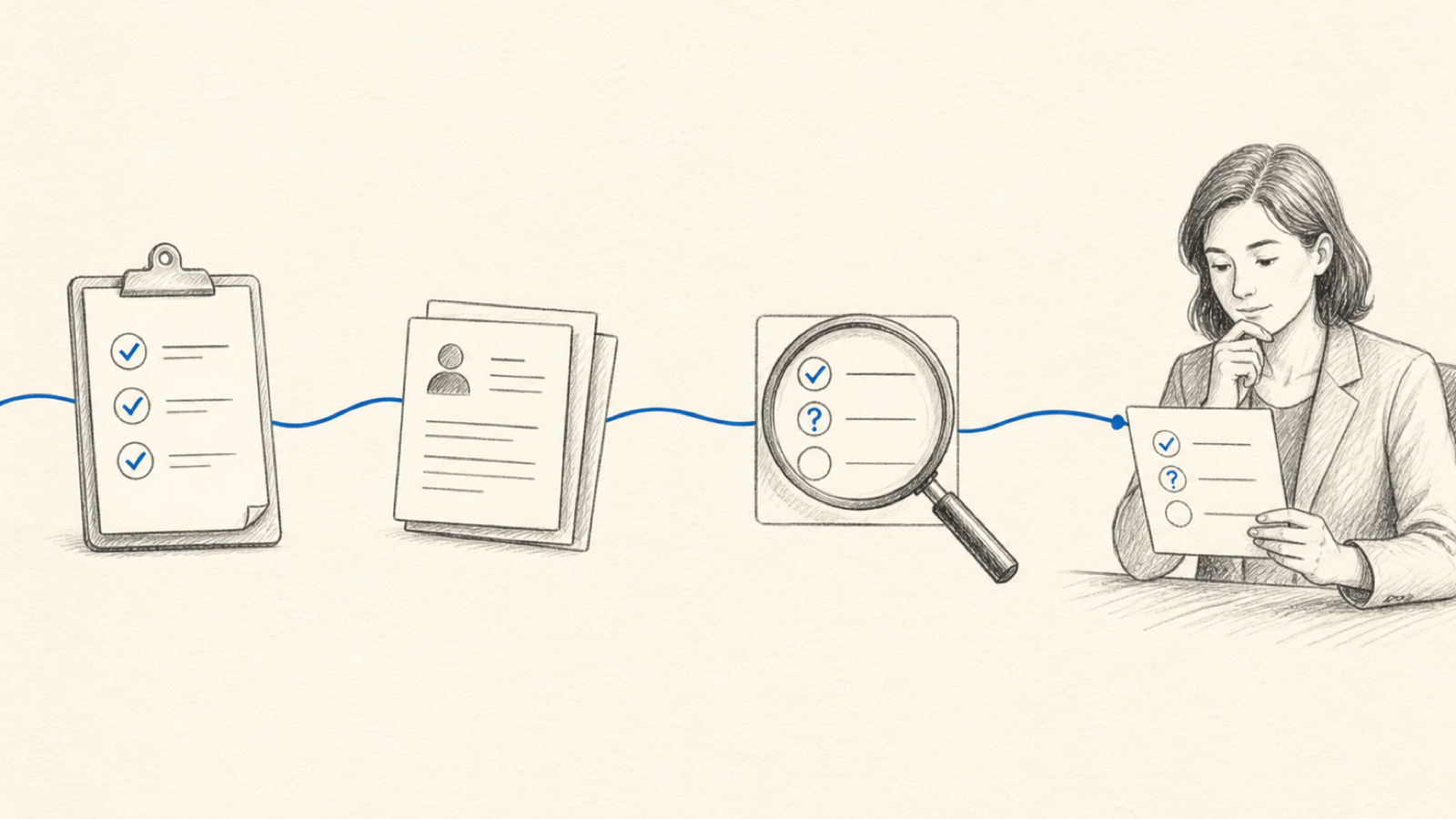
A responsible workflow begins before the first resume is opened. The hiring team defines what the job actually requires, the system analyzes applications against those requirements, and a person reviews the resulting evidence. If the criteria are vague or unrealistic, AI will only apply bad thinking more efficiently.
1. Turn the job into a usable rubric
Separate true requirements from preferences. A required professional license is different from “experience at a top company.” Three years using a particular framework may be a proxy for the ability you need, not the ability itself. Write down the evidence that would satisfy each criterion before looking at candidates. This reduces the temptation to move the goalposts for one profile and not another.
2. Read the original application
The system should analyze the source document, not only a brittle set of extracted fields. Structured extraction is helpful for search and reporting, but the original resume preserves layout, project grouping, dates, and context that may be lost when a PDF is flattened into database columns.
3. Connect claims to job-related evidence
For each criterion, the screener should show the sentence, project, role, or qualification that supports its conclusion. “Strong match” is not an explanation. “Led a five-person implementation of the same data warehouse pattern this role will own” is evidence a recruiter can inspect and discuss.
4. Keep missing and conflicting information separate
No evidence is not the same as negative evidence. If a resume does not mention a certification, the candidate may not have it—or may simply have left it out. If two dates conflict, that is a different kind of signal. A useful system labels uncertainty honestly instead of filling the gap with a confident guess.
5. Recommend a review action, not a verdict
The output should help the recruiter decide what to do next: advance for review, ask a clarifying question, verify a required qualification, or inspect a possible inconsistency. That is more actionable than a single percentage, and it makes the human checkpoint real rather than ceremonial.
What AI resume screening can evaluate well
AI is useful when the question is grounded in information that is actually present. It can read a large application pool using a consistent structure and bring relevant details closer to the surface. Depending on the role and the quality of the application, that can include:
- Explicit skills, tools, certifications, languages, and qualifications tied to the job.
- Employment dates, role progression, scope of responsibility, and patterns across several positions.
- Projects and accomplishments that provide evidence for a required capability.
- Transferable experience expressed with different terminology than the job description.
- Important questions created by unclear timelines, unsupported claims, or missing required information.
This is where language models can be more useful than exact keyword filters. A candidate may describe “customer discovery” while the job description says “voice-of-customer research.” Those phrases are not identical, but the underlying work may be relevant. The model can surface that connection—as long as it also shows the recruiter why it made it.
What AI resume screening can miss
A resume does not contain the whole candidate, so a resume screener cannot evaluate the whole candidate. Some of the most important limitations are fairly ordinary:
- Strong abilities the candidate did not describe, especially when they are not practiced at writing resumes.
- Non-standard job titles, career changes, consulting arrangements, small-company roles, or work completed under an agency name.
- The circumstances behind employment gaps, short tenures, overlapping dates, or a move between industries.
- Whether an accomplishment is accurate, exaggerated, copied, or primarily the work of somebody else.
- Potential, learning speed, collaboration style, judgment, motivation, and how the person responds when the work gets messy.
- Context related to disability or a reasonable accommodation that should not be converted into a negative screening signal.
There is also a quieter risk: automation bias. Once a system places a number beside a person, reviewers can start looking for reasons the number is correct. NIST’s AI Risk Management Framework notes that human-AI interaction can sometimes amplify bias rather than cancel it. Human oversight only works when the reviewer has enough context, authority, and time to disagree.
An AI-written resume is not automatically a fraudulent resume
Candidates use writing tools. Recruiters do too. Using AI to improve grammar, organize experience, or tailor a truthful resume to a job is not the same as inventing a degree, employer, project, or skill. Screening based on whether the prose “sounds AI-written” is a weak shortcut and will create false conclusions.
The useful question is not who helped write the sentence. It is whether the material claim is accurate and whether the candidate can discuss the work behind it. That calls for evidence-based review: compare the application with the stated criteria, ask specific follow-up questions, and verify consequential claims through an appropriate process when needed.
Application fraud can be serious. The U.S. Department of Justice has documented remote-worker schemes involving stolen identities, false accounts, and deceptive employment arrangements. But serious fraud is exactly why hiring teams should distinguish a real inconsistency from a stylistic hunch. A polished paragraph is not proof. Neither is an awkward one.
We explain Celect’s broader approach to application signals in Introducing Celect and Cai. The short version is that a signal should lead to a fair question or a verification step, not an instant accusation.
A practical human-controlled screening workflow
You do not need a 40-page AI policy before you can improve resume review. You do need a process that makes responsibility visible. This is a good starting point:
- Approve the role rubric before applications are scored. Record which requirements are essential, which are preferred, and what evidence can satisfy each one.
- Apply the same job-related criteria to the full applicant pool. Do not quietly create a different standard for a familiar employer, school, name, or career path.
- Require evidence with every recommendation. A recruiter should be able to open the source resume and see what produced the conclusion.
- Route uncertainty to review. Missing information, extraction errors, and conflicting claims should have different labels and different next actions.
- Provide a meaningful human checkpoint before rejection or advancement. The reviewer needs permission to override the system and a place to record why.
- Tell candidates what automated tools are used when applicable, provide the notices required for the employer and location, and maintain an accommodation process.
- Monitor outcomes after launch. Look for unusual exclusion patterns, recurring extraction failures, rubric drift, reviewer overreliance, and criteria that are not predicting useful interviews.
This approach takes a little discipline up front, but it usually saves time later. Recruiters spend less energy reconstructing why a candidate was ranked, hiring managers get a clearer shortlist, and candidates are less likely to disappear because a tool misunderstood one line.
Bias, accessibility, and legal responsibility
Employment decisions are consequential, and adding AI does not transfer the employer’s responsibility to a vendor. The EEOC has warned that algorithmic tools can screen out people with disabilities and has emphasized reasonable accommodations and safeguards. New York City’s rules for covered automated employment decision tools include bias-audit, publication, and candidate-notice requirements.
Requirements vary by jurisdiction, tool, and how the system affects the decision. This article is not legal advice, and a generic “compliant AI” badge should not replace a review by qualified counsel. The practical point is simpler: know what the system does, know which decisions it influences, document the human role, and test the process rather than relying on a vendor description.
Responsible screening is not only a legal exercise either. It is product quality. If a recruiter cannot understand a result, correct bad input, or give a candidate a fair route around an error, the workflow is not ready for consequential use.
What to ask an AI resume screening vendor
A polished demo can hide the part that matters. Ask the vendor to screen a small, representative set of applications and walk through the output in detail. These questions will tell you more than a feature list:
- Can we define and approve the rubric before screening begins?
- Does every recommendation link back to evidence in the source application?
- How does the system distinguish missing information from contradictory information?
- Can reviewers override a recommendation and record a reason?
- Can we inspect the original document when parsing fails?
- What applicant data is stored, where is it processed, and how long is it retained?
- What bias, accessibility, security, and performance testing has been completed for this specific workflow?
- What happens when the model, an integration, or a document extraction step fails?
Pay attention to how the vendor answers uncertainty. Good systems have boundaries. If every question gets a perfect answer and every candidate gets a precise score, you may be looking at confidence theater rather than a dependable hiring tool.
How Celect approaches AI-assisted screening
At Celect, we are building screening around the original application, the job context, and a structured analysis a recruiter can inspect. The goal is not to make a PDF disappear into a black box. It is to reduce the repetitive reading while keeping the reasons close to the recommendation.
Cai can organize job-relevant evidence, surface gaps or inconsistencies that deserve attention, and prepare a more useful first review. The recruiter still decides what the criteria mean, whether the evidence is persuasive, what follow-up question is fair, and whether the person advances.
We also treat application integrity as part of the same candidate context, not a separate red-or-green verdict. A finding can be consistent, unverified, or conflicting. Those states should not be collapsed into “fraud,” because they require different questions and different levels of care.
The product will keep evolving, and we will keep documenting where automation helps and where it needs a person. That honesty is important. Hiring software should earn trust through evidence and control, not through bigger claims about replacing recruiters.
The real test is whether the recruiter can disagree
AI resume screening can save hours and help every application receive a structured first look. That is valuable. But the quality of the workflow is not measured by how quickly it produces a ranking. It is measured by whether the criteria are job-related, the evidence is visible, uncertainty is handled honestly, and a recruiter can challenge the output before it affects a person.
If your team can explain why someone moved forward, what information was missing, and where human judgment changed the result, AI is probably supporting the process. If nobody can explain the score but everybody trusts it, the system is running more of the hiring decision than it should.
Questions answered
Frequently asked questions
What is AI resume screening?
AI resume screening uses machine-learning or language-model systems to compare information in resumes and applications with job-related criteria. A responsible system organizes supporting evidence, missing information, and questions for a recruiter rather than making an unexplained final decision.
How does AI resume screening work?
The hiring team first defines a job rubric. The system reads the original application, identifies evidence related to each criterion, separates matches from gaps or uncertainties, and prepares a recommendation for human review. Exact workflows vary by product.
What can AI resume screening identify?
It can identify explicit skills, qualifications, employment history, projects, dates, role progression, and evidence related to a job requirement. It can also surface missing or potentially inconsistent information, but those findings still need contextual human review.
Should AI automatically reject job candidates?
Celect recommends a meaningful human review before a screening result causes rejection or advancement. Automated tools can misunderstand context, use weak criteria, or make extraction errors. Employers should also evaluate the legal requirements that apply to their location and workflow.
Is an AI-written resume considered application fraud?
Not automatically. Using AI to improve wording or organize truthful experience is different from inventing a qualification, employer, project, or skill. Recruiters should evaluate the accuracy and relevance of material claims instead of guessing who wrote the prose.
Can AI resume screening be biased?
Yes. Bias can enter through job criteria, data, model behavior, document extraction, reviewer behavior, and the surrounding hiring process. Teams should use job-related rubrics, preserve evidence, allow overrides, test outcomes, provide accommodations, and investigate unusual exclusion patterns.
Is AI resume screening legal?
Legality depends on the jurisdiction, the tool, and how it influences employment decisions. Anti-discrimination and disability laws still apply, and some locations impose additional audit or notice requirements. Employers should obtain qualified legal advice for their specific use rather than relying only on a vendor claim.
What should recruiters look for in AI resume screening software?
Look for configurable job-related criteria, evidence linked to the original application, clear handling of missing and conflicting information, meaningful human review, override records, privacy and retention controls, accessibility safeguards, outcome monitoring, and transparent failure behavior.
Evidence
Sources and research inputs
Official government and standards sources support the article’s responsible-AI, human-oversight, disability, automated-employment-tool, and documented identity-fraud sections. They do not endorse Celect. Product descriptions were checked against Celect’s current screening workflow on August 6, 2026.
- AI Risk Management FrameworkNational Institute of Standards and Technology · 2023-01-26Provides the voluntary framework for governing, mapping, measuring, and managing AI risks and trustworthy AI characteristics.
- AI Risk Management and Human-AI InteractionNational Institute of Standards and TechnologyExplains why human roles, responsibilities, context, and oversight should be explicitly defined in human-AI decision workflows.
- U.S. EEOC and U.S. Department of Justice Warn against Disability DiscriminationU.S. Equal Employment Opportunity Commission · 2022-05-12Describes disability-discrimination risks, reasonable accommodations, and safeguards when software or AI is used in employment decisions.
- Automated Employment Decision ToolsNew York City Department of Consumer and Worker ProtectionSummarizes bias-audit, public-disclosure, and candidate-notice requirements for covered automated employment decision tools.
- Justice Department Disrupts North Korean Remote IT Worker Fraud SchemesU.S. Department of Justice · 2024-08-08Documents a remote-employment fraud scheme involving stolen identity, deceptive accounts, and concealed access arrangements.
Continue exploring
Screen every application without losing the human judgment
Use Cai to organize job-related evidence, surface useful questions, and give recruiters a clearer first review of every application.

