The 10 Best Agentic AI Recruiting Platforms in 2026
What Each One Actually Automates
A transparent, practical comparison of ten agentic AI recruiting platforms—what each one automates, who it fits, where humans stay in control, and what buyers should verify.

Direct answer
The best agentic AI recruiting platform depends on the workflow: Celect for a connected hiring workspace, hireEZ for an action layer above an ATS, Joveo for recruitment marketing, Eightfold for enterprise talent intelligence, Paradox and Fountain for high-volume workflows, LinkedIn Hiring Assistant for LinkedIn-native sourcing, and SeekOut, Moonhub, or Findem for specialized talent discovery and delivery models.
“Agentic AI” became one of recruiting’s favorite phrases in 2026. It is now attached to sourcing tools, chatbots, applicant-screening products, scheduling assistants, recruitment-marketing platforms, and full talent suites. Some of those products really can carry a multi-step workflow. Others are useful copilots wearing a more ambitious label.
That does not make the category meaningless. It means buyers need to ask a more concrete question: after I give this system a goal, what work will it actually finish before a person has to step in? A good answer can be demonstrated. The agent reads the role, builds or refines a plan, acts across one or more steps, keeps context, and stops at a sensible human checkpoint. A vague answer usually ends with “it generates a suggestion.”
This guide compares ten platforms that go beyond generic writing assistance and can carry at least one meaningful recruiting workflow. They are not interchangeable, and the order below is not a universal score. A platform that is excellent for hourly hiring may be the wrong choice for executive search. A powerful enterprise suite may be unnecessary for a six-person company.
The short answer
The best agentic AI recruiting platform depends on the workflow you need to move. Celect is a practical option for growing teams that want connected hiring workflows and public pricing. hireEZ is strong when an existing ATS needs a system of action on top of it. Joveo is built for recruitment marketing and high-volume orchestration. Eightfold AI is aimed at enterprise talent intelligence. Paradox and Fountain are compelling for conversational and frontline hiring. LinkedIn Hiring Assistant is the natural choice for LinkedIn-native sourcing. SeekOut, Moonhub, and Findem each approach hard-to-find talent from a different angle: software, managed recruiting capacity, and data-rich multichannel sourcing.
| Platform | Best for | Work it can carry | Pricing / access |
|---|---|---|---|
| Celect | Growing teams wanting a connected hiring workspace | Role setup, candidate review, communication, interview coordination, pipeline work, reporting | Public plans from $99/month |
| hireEZ | Adding an action layer to an existing ATS | Research, sourcing, qualification, outreach, screening, scheduling | Contact sales |
| Joveo | Recruitment marketing and high-volume orchestration | Job advertising, career sites, engagement, screening, scheduling, interviews, analytics | Contact sales |
| Eightfold AI | Enterprise talent intelligence and end-to-end TA | Talent discovery, matching, screening, interviewing, offers, internal mobility | Contact sales |
| Paradox | Conversational and high-volume candidate workflows | Job discovery, mobile apply, screening, scheduling, reminders, onboarding | Contact sales |
| LinkedIn Hiring Assistant | LinkedIn-native sourcing and applicant review | Intake, repeated searches, shortlists, outreach drafts, pre-screening | Recruiter add-on; contact sales |
| SeekOut | Hard-to-find talent and flexible sourcing models | Outbound sourcing, inbound evaluation, engagement, or AI-plus-expert delivery | Free trial for Recruit; sales-led plans |
| Fountain | Frontline and hourly hiring operations | Sourcing, candidate communication, screening, scheduling, workforce operations | Contact sales |
| Moonhub | Teams wanting a recruiting partner powered by AI | Sourcing, qualification, personalized outreach, engagement, expert handoff | Sales-led managed service |
| Findem | Multichannel sourcing and continuously refreshed talent data | Role-to-search criteria, slate building, ATS rediscovery, relationship signals | Contact sales; some agents are early access |
What “agentic” should mean in recruiting
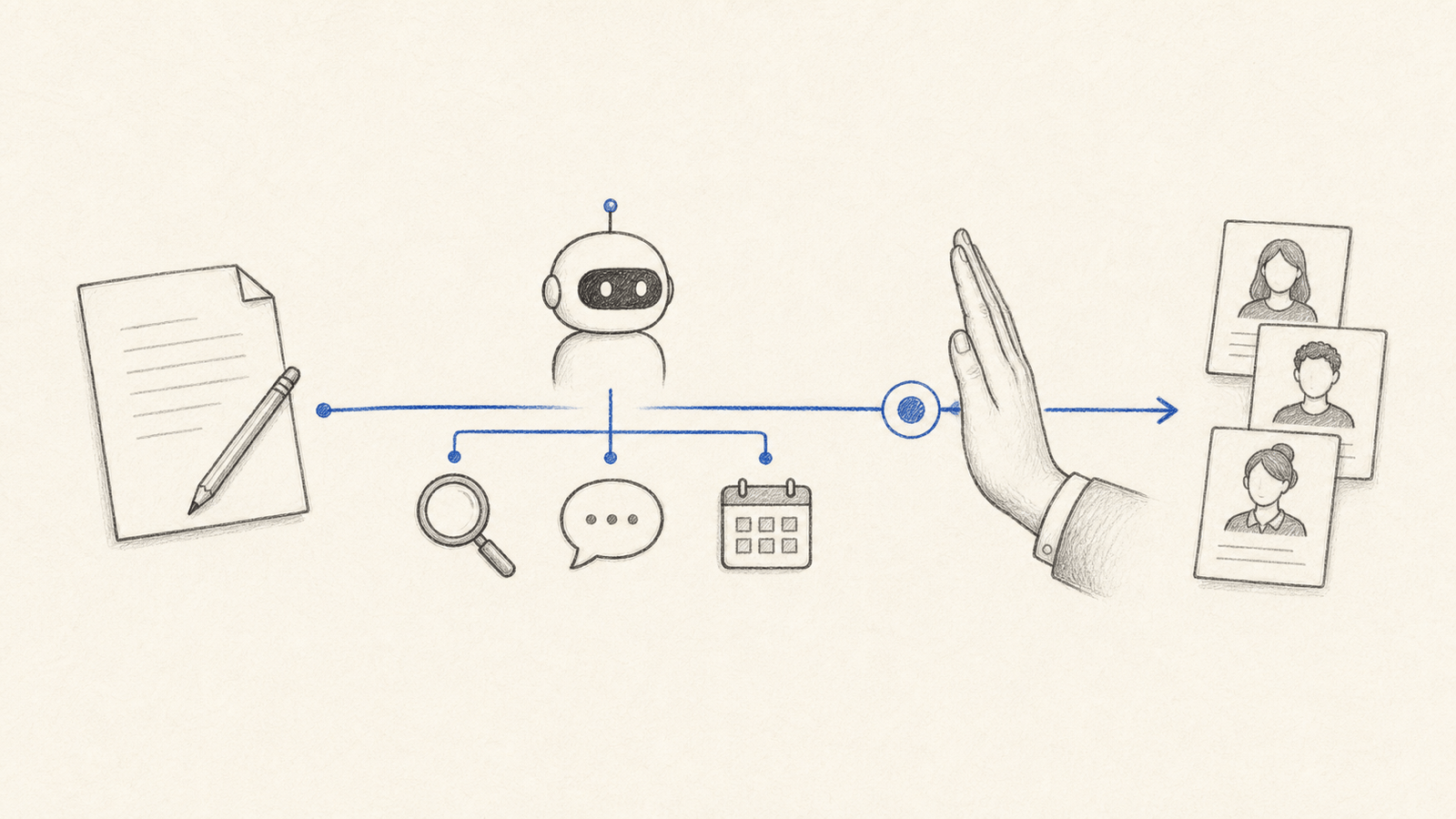
Ordinary automation follows a rule: when a candidate reaches this stage, send this message. Generative AI creates an artifact: draft a job description or summarize these notes. Agentic software is supposed to carry a goal through a sequence: understand the role, decide which searches to run, inspect the results, adjust, prepare outreach, and bring a qualified set of candidates back for review.
The boundary is not perfectly clean. Most serious recruiting products combine all three modes. The useful distinction is how much state and responsibility the system carries between steps. I use five tests when a vendor calls a product agentic:
- It accepts an outcome, not only a single command. “Build a slate for this role” is different from “write a Boolean query.”
- It chooses and completes multiple actions. The sequence may include research, search, evaluation, outreach, or coordination.
- It carries context forward. Recruiters should not have to re-explain the role, preferences, or prior decisions at every screen.
- It can show what it did. A recruiter needs enough evidence to inspect the work, correct it, and understand the source of a recommendation.
- It has an intentional handoff. Employment decisions should not disappear into an autonomous flow simply because the software can keep moving.
That last test is not anti-automation. It is what makes automation deployable. Teams are more likely to trust an agent when they know which actions it may take alone, which actions need approval, and how to interrupt the workflow when the context changes.
How we chose and compared the ten platforms
This is a buyer’s guide, not a laboratory benchmark. We reviewed current first-party product pages, documentation, pricing pages, and announcements on August 3, 2026. A platform qualified if it could complete at least one multi-step recruiting workflow beyond generic content generation or a static candidate score.
We compared the products on six practical dimensions:
- Workflow depth: what the system can execute from start to finish.
- Breadth: whether it is focused on one bottleneck or coordinates several parts of recruiting.
- Human control: where recruiters can review, refine, approve, or stop the work.
- System fit: whether it replaces an ATS, sits on top of one, lives inside a network, or arrives as a managed service.
- Buyer fit: the team size, hiring motion, and recruiting problem the product appears designed to solve.
- Commercial clarity: whether pricing and availability are public, sales-led, or still in early access.
We did not turn those dimensions into a fake 9.4-versus-9.2 score. The products solve different problems, and an exact score would imply testing and weighting that did not happen. Instead, each entry explains where the product is strongest and what a buyer should verify in a demo.
The 10 best agentic AI recruiting platforms in 2026
1. Celect — best for connected hiring workflows with visible human control
Celect is built around Cai, an AI recruiting assistant that works across the hiring process rather than living in a single sourcing or scheduling feature. A team can use the platform to define a role, organize applications around job-relevant context, prepare candidate communication, coordinate interview work, maintain the pipeline, and understand what is happening through reporting. The aim is to keep the context connected as the job moves from intake to decision.
The strongest fit is a growing team that wants more execution than a basic ATS provides but does not want to assemble a large enterprise stack. Celect also publishes standard plans, currently starting at $99 per month, which gives smaller buyers a useful commercial reference before a sales call.
The human-control model is an important part of the product. Cai can prepare and coordinate work, but the recruiter remains responsible for consequential actions and final employment decisions. That is especially important when application-integrity or candidate-ranking signals are involved: a signal should lead to review, not an unexplained rejection.
What to verify: Celect is a newer platform than several enterprise vendors in this guide. Ask which ATS, calendar, email, verification, and storage integrations are available for your plan today; which actions Cai can execute versus prepare; and how your team will review the evidence behind candidate signals. Plan limits and feature availability can change, so the current pricing page and a workflow demo should be the source of truth.
2. hireEZ — best for putting an agentic action layer on top of an ATS
hireEZ describes itself as a system of action that sits on top of the ATS a company already uses. That architecture is the point. The ATS remains the system of record, while hireEZ’s EZ Agent carries work across research and intake, open-web and internal sourcing, qualification, outreach, applicant review, screening, and interview scheduling.
This is a strong match for a talent team that has already invested in Workday, iCIMS, Greenhouse, SAP, or another major ATS but still watches recruiters jump between sourcing tools, inboxes, calendars, and spreadsheets. The platform’s current site says it searches external networks and the talent already inside the ATS, then keeps the workflow moving toward a scheduled interview.
The practical appeal is consolidation without a rip-and-replace project. A recruiter can begin with the role, let the agent build a sourcing strategy and candidate pool, review the proposed matches, and carry approved outreach and scheduling forward. That is closer to an agentic workflow than a tool that stops after producing a list.
What to verify: map every promised action to your specific ATS integration. Ask what reads from the ATS, what writes back, how duplicate records are handled, which outreach channels are included, and whether screening outputs expose the underlying evidence. Pricing is sales-led, so the real comparison should include implementation, data access, messaging, and support—not only the license.
3. Joveo — best for recruitment marketing and high-volume orchestration
Joveo starts earlier in the funnel than many recruiting agents. Its platform spans programmatic job advertising, social advertising, career sites, candidate engagement, conversational screening, scheduling, AI interviews, talent CRM work, and analytics. That breadth makes it particularly relevant when the hard problem is not merely finding names—it is continuously attracting and converting enough qualified applicants across roles, locations, and channels.
The agentic idea here is orchestration. Separate agents can optimize advertising, personalize candidate journeys, answer questions, screen applicants, schedule interviews, and make recruiting data easier to query. Joveo also emphasizes ATS integrations, which matters because recruitment marketing is only useful when candidate progress makes it back to the operating system used by recruiters.
Joveo is a natural shortlist candidate for large employers, staffing firms, RPOs, or distributed hourly hiring programs where media spend, application conversion, and pipeline volume are major constraints. It may also consolidate several point solutions when job advertising, career-site experience, screening, and analytics are owned by different vendors.
What to verify: breadth can become implementation work. Ask which agents are packaged together, how budget optimization is governed, whether screening or interview recommendations can be audited, how your ATS integration behaves, and which outcomes are measured from first click through hire. Treat the performance numbers on vendor pages as claims to validate against a comparable customer and your own baseline.
4. Eightfold AI — best for enterprise talent intelligence across internal and external hiring
Eightfold AI is broader than a sourcing agent. Its talent-acquisition suite is built around a talent-intelligence layer that can support candidate discovery, matching, screening, interview workflows, offers, and internal mobility. For a global enterprise, the useful idea is not simply automating a recruiter’s clicks. It is connecting jobs, skills, candidates, employees, and workforce plans across a larger talent system.
That makes Eightfold most relevant when recruiting is tied to skills strategy and internal talent movement. A company may want to consider external applicants and existing employees together, surface adjacent skills rather than exact title matches, and give recruiting leaders a consistent view across business units. Enterprise hiring agents and AI interview capabilities extend that intelligence into more of the workflow.
The tradeoff is scope. A talent-intelligence suite affects data models, governance, integrations, candidate experience, and internal mobility—not just recruiter productivity. It can be the right platform-level decision for a large organization and far more than a smaller team needs.
What to verify: ask which agentic capabilities are generally available in your region and product package, what systems supply the skills and candidate data, how recommendations are explained, and how employees and external applicants are treated differently. Procurement should include HRIS and ATS owners, privacy and legal teams, and the people accountable for adoption after launch. Pricing is available through sales.
5. Paradox — best for conversational hiring and complex scheduling at volume
Paradox’s assistant, Olivia, is designed around candidate conversations. It helps people discover jobs, complete mobile applications, answer screening questions, receive updates, and schedule or reschedule interviews. On the recruiter side, it coordinates calendars, reminders, multi-person interviews, and parts of onboarding. The interaction model is conversational, but the value comes from the operational workflow behind the conversation.
This is especially useful in retail, restaurants, hospitality, healthcare, manufacturing, logistics, and other environments where hiring volume is high and candidate delay is expensive. A person applying from a phone after a shift should not need to wait two business days for an email just to choose an interview time.
Paradox is also attractive when scheduling is genuinely complicated. Its current product page describes calendar synchronization, reminders, rescheduling, and coordination across people and locations. Removing that back-and-forth can create capacity without asking an agent to make the hiring decision.
What to verify: confirm the conversational flows for your roles, languages, locations, accommodation process, and ATS. Ask how the system handles an unexpected candidate question, when a recruiter takes over, and whether screening rules can create unfair drop-off. If proactive sourcing is your primary problem, compare Paradox with platforms built more deeply around talent discovery. Pricing is sales-led.
6. LinkedIn Hiring Assistant — best for LinkedIn-native sourcing and engagement
LinkedIn Hiring Assistant has one structural advantage that is difficult to reproduce: it works inside the professional network and Recruiter environment many sourcing teams already use. The assistant can turn intake into a sourcing strategy, run multiple searches, learn from recruiter feedback, evaluate applicants from LinkedIn and supported ATS integrations, prepare a shortlist, draft personalized outreach, and pre-screen interested candidates.
For a team whose recruiting motion already revolves around LinkedIn Recruiter, the adoption path is straightforward. Recruiters do not have to export a role into a separate search interface or learn an entirely new candidate dataset. The assistant also remains bounded: LinkedIn says customers choose which projects and tasks use it and can provide feedback throughout the process.
It is best understood as an agentic layer inside LinkedIn’s hiring products, not as a replacement for the rest of the recruiting stack. Scheduling, interview operations, offer management, and broader pipeline orchestration may still live elsewhere.
What to verify: Hiring Assistant is sold as an add-on to LinkedIn Recruiter. Confirm availability, languages, ATS integration support, seat and project rules, and which data travels between systems. Ask to see how feedback changes a search and how the assistant explains why a candidate is on the shortlist. LinkedIn publishes product-usage results, but your pilot should measure qualified-response and conversion outcomes for your own roles.
7. SeekOut — best for hard-to-find talent and flexible AI-plus-expert sourcing
SeekOut now offers two meaningfully different ways to buy recruiting capacity. SeekOut Recruit is software for sourcing, screening, inbound evaluation, ATS rediscovery, and personalized engagement. SeekOut Spot combines AI agents with expert recruiters who guide the search and deliver interview-ready candidates. Both are aimed at reducing the time between an open role and a credible pipeline, but the operating model is not the same.
Recruit makes sense for an internal team that wants direct control over searches and outreach. Spot is closer to flexible recruiting capacity: the buyer describes the need, AI agents do a large portion of the finding and engagement, and SeekOut’s people refine the work. That can appeal to teams hiring in bursts or searching for specialized technical, healthcare, or cleared talent without adding permanent headcount.
The distinction is important because software and a managed outcome should not be evaluated with the same spreadsheet. One changes the recruiter’s workflow; the other changes who performs part of the recruiting work.
What to verify: decide whether you want a platform, a service, or both. For Recruit, inspect data coverage, ATS rediscovery, outreach controls, and the evidence used for evaluation. For Spot, ask who owns candidate communication, how expert review works, what happens when the brief changes, and how fees relate to searches or hires. SeekOut advertises a trial for Recruit; broader commercial terms are sales-led.
8. Fountain — best for frontline hiring and workforce operations
Fountain is focused on the frontline workforce, where hiring often involves thousands of candidates, many locations, repeated role types, high drop-off, and very little time for manual follow-up. In April 2026, the company announced Cue, a multi-agent system intended to carry work across sourcing, candidate communication, screening, scheduling, and workforce operations.
That focus matters. Frontline recruiting is not enterprise knowledge-work recruiting at a larger volume. Candidates frequently apply on mobile devices, hiring standards may vary by location, managers need quick handoffs, and a slow response can lose an applicant to the next employer. An agent that can keep the candidate moving and coordinate the local workflow has a clear job to do.
Fountain is a strong candidate for retailers, delivery and logistics networks, hospitality groups, healthcare support organizations, franchise systems, and other employers with repeatable high-volume hiring. Its workforce-operations direction may also matter to buyers who want continuity after the hire rather than a tool that stops at an accepted offer.
What to verify: Cue is a recent product, so distinguish the announced vision from the workflows available to your account today. Ask which agents are live, what each may do autonomously, how location-specific rules are configured, how candidates reach a person, and how the platform handles accessibility and language needs. Pricing is available through Fountain’s sales process.
9. Moonhub — best for teams that want an AI-powered recruiting partner
Moonhub is the least conventional software comparison in this list because it presents itself as an AI recruiting partner, not simply a self-serve platform. Its talent experts deploy proprietary agents to identify and qualify candidates, run personalized outreach, monitor engagement, and hand promising people into the hiring process.
That model can be useful for a founder, lean people team, or company entering a difficult talent market. Instead of buying a tool and assigning internal recruiters to operate it, the buyer is purchasing a combination of technology, data, and expert recruiting capacity. Moonhub also emphasizes technical and global talent, which may appeal to companies building specialized product and engineering teams.
The advantage is speed to operational capacity. The tradeoff is that buyers have less direct control than they would with a pure software platform, and the commercial model may resemble a recruiting engagement more than a monthly SaaS subscription.
What to verify: ask exactly which work is performed by agents and which is performed by Moonhub’s talent experts. Clarify candidate ownership, outreach domains, data provenance, replacement or success terms, handoff expectations, and what reporting remains available when an engagement ends. Compare total cost and internal time with both recruiting agencies and self-operated software, not with a license price alone.
10. Findem — best for multichannel sourcing with rich, continuously refreshed talent data
Findem’s generally available Copilot for Sourcing turns an open role into search criteria and a prioritized slate across inbound applicants, ATS records, CRM communities, referrals, alumni, employee connections, and external sources. It carries role context across those channels so a recruiter does not have to rebuild the same search in six places.
The product’s differentiation is its talent data and relationship context. Findem says profiles are continuously refreshed and that recommendations can include prior engagement, shared connections, and channel history—not only resume keywords. Recruiters can still refine titles, skills, experience, Boolean logic, and other criteria. That combination of automated slate building and editable logic is useful when the team wants speed without giving up search craft.
Buyers should separate the mature sourcing product from newer agentic experiences. Findem’s Fia voice and chat assistant is offered through early access, and the Intelligent Job Post workflow—described as agents supporting calibration, sourcing, screening, and scheduling—has also been promoted through an early-access or design-program path. Those may be strategically interesting without being part of today’s standard deployment.
What to verify: ask for a feature-by-feature availability map. Confirm which sources are included, how profiles are refreshed and verified, what your licenses permit, how ATS and CRM data are reconciled, and which agentic workflows are generally available. Pricing is sales-led, so implementation and data coverage should be included in the commercial comparison.
How to choose the right platform for your team
Do not start by asking which vendor has the most agents. Start with the recruiting work that repeatedly fails, slows down, or consumes expensive human time. Then evaluate whether the product can carry that exact workflow in your environment.
- Name one bottleneck in operational language. “We need AI” is not a use case. “Recruiters spend twelve hours a week rebuilding searches and following up with unresponsive candidates” is.
- Choose the architecture. Decide whether you need a new hiring platform, a system of action above your ATS, an assistant inside an existing network, or a managed recruiting service.
- Demand a live workflow, not a highlight reel. Bring a representative role and ask the vendor to show intake, agent actions, recruiter review, failure handling, and the write-back into your systems.
- Mark every human checkpoint. Decide who approves search criteria, outreach, screening progression, interviews, and final employment decisions. If nobody can draw the boundary, the workflow is not ready.
- Inspect data and integrations. Ask what data the agent reads, where it came from, how fresh it is, what the agent writes, how duplicates are handled, and what happens when an integration fails.
- Pilot against a baseline. Measure qualified candidates reviewed, response rate, time to first contact, scheduling delay, candidate drop-off, recruiter hours, hiring-manager satisfaction, and downstream quality signals. Do not optimize only for activity.
- Talk to candidates and recruiters after the pilot. A workflow can look fast in a dashboard while creating confusing messages, repetitive questions, or hidden cleanup work for the people using it.
A practical shortlist by hiring situation
If I were narrowing the category before demos, I would use this starting point:
- Small or growing team seeking one connected hiring workspace: Celect.
- Enterprise team keeping its ATS but replacing fragmented execution tools: hireEZ.
- Recruitment-marketing organization managing media, conversion, and high applicant volume: Joveo.
- Global company connecting external hiring with skills and internal mobility: Eightfold AI.
- High-volume candidate conversation and interview scheduling: Paradox.
- Sourcing team already centered on LinkedIn Recruiter: LinkedIn Hiring Assistant.
- Hard-to-find talent with a choice between recruiter-operated software and expert-assisted delivery: SeekOut.
- Frontline, hourly, or multi-location workforce hiring: Fountain.
- Lean team that wants a recruiting partner rather than another system to operate: Moonhub.
- Talent team prioritizing multichannel slate building and relationship-aware data: Findem.
That list should produce two or three demos, not a purchase order. The final decision still depends on your ATS, hiring volume, geography, candidate population, security requirements, implementation capacity, and the workflow evidence a vendor can show with your role.
Do not buy recruiting autonomy without governance
Recruiting agents operate in a consequential system. Even when the agent does not make the final decision, it can influence who gets found, who receives attention, what questions are asked, and how quickly someone moves. “A human is in the loop” is not enough if that person cannot inspect the evidence or realistically override the system.
The NIST AI Risk Management Framework recommends defining roles, responsibilities, oversight, and ongoing risk management for human–AI systems. The U.S. Equal Employment Opportunity Commission has also warned that employers can be responsible when algorithmic hiring tools disadvantage applicants with disabilities. In New York City, covered automated employment decision tools can trigger bias-audit, publication, and notice requirements. Other jurisdictions have their own rules, and this article is not legal advice.
Before launch, document the job-related criteria, data sources, automated actions, approval points, accommodation path, candidate notices, retention rules, monitoring plan, and incident owner. Ask how model or workflow changes are communicated. Keep enough logs to reconstruct what happened without collecting information merely because it is available.
The final take
The agentic recruiting market is not converging on one product shape. It is splitting into connected hiring platforms, ATS action layers, enterprise talent suites, network-native assistants, high-volume conversational systems, sourcing engines, and managed AI recruiting services. That is healthy. Recruiting has more than one bottleneck.
The winning platform for your team will not be the one with the loudest autonomy claim. It will be the one that can carry a real piece of work, fit the systems you already depend on, stop where human judgment is required, and show enough evidence for people to trust the result.
Pick the workflow first. Ask the agent to do it in front of you. Then look past the polished output and inspect the handoffs, data, exceptions, and decisions underneath. That is where an impressive demo becomes a hiring system your team can actually use.
Questions answered
Frequently asked questions
What is an agentic AI recruiting platform?
An agentic AI recruiting platform accepts a recruiting goal, chooses and completes multiple actions, carries context between steps, and returns the work for review at an intentional human checkpoint. It goes beyond producing a single job description, search query, summary, or candidate score.
How is agentic AI different from ordinary recruiting automation?
Ordinary automation follows predefined triggers and rules, while generative AI usually creates one artifact. Agentic AI can plan and carry a sequence such as role intake, search, qualification, outreach, and scheduling, adapting the next action to what happened earlier in the workflow.
Can an AI recruiting agent replace an ATS?
Sometimes a broader hiring platform includes ATS-like workflow and record keeping, but many recruiting agents are designed to sit on top of an existing ATS. Buyers should decide whether they need a new system of record, a system of action above the ATS, an assistant inside an existing network, or a managed service.
Can an AI recruiting agent replace recruiters?
A recruiting agent can carry research, sourcing, communication, screening support, scheduling, and coordination work, but people should remain accountable for job criteria, exceptions, candidate conversations, accommodations, and consequential employment decisions.
Which agentic AI recruiting platform is best for a small or growing team?
Celect is designed as a connected hiring workspace with public plans starting at $99 per month, making it a practical option for a growing team. SeekOut Recruit may fit a sourcing-heavy team, while Moonhub is worth considering when the team wants managed recruiting capacity instead of another platform to operate.
Which platform is best for enterprise or high-volume hiring?
Eightfold AI is positioned for enterprise talent intelligence, hireEZ for action on top of an enterprise ATS, Joveo for recruitment marketing and orchestration, Paradox for conversational hiring, and Fountain for frontline workforce hiring. The right choice depends on which workflow creates the bottleneck.
What should a company verify before buying an AI recruiting agent?
Verify the exact actions available today, data sources, ATS write-back, failure handling, human approval points, explanation and audit controls, accessibility and accommodation process, security, feature availability by region and plan, implementation cost, and results against a pre-pilot baseline.
How much do agentic AI recruiting platforms cost?
Pricing varies by product and operating model. Celect publishes plans starting at $99 per month, SeekOut advertises a Recruit trial, and most enterprise platforms in this guide use sales-led pricing. Managed services such as Moonhub may be priced more like a recruiting engagement than a software seat.
Evidence
Sources and research inputs
Research was last checked on August 3, 2026 using official vendor product pages, documentation, pricing surfaces, and announcements. Celect publishes this comparison and is included with a visible disclosure. The article does not claim independent hands-on testing of every product. Product capabilities, prices, integrations, packaging, and availability can change; readers should verify them directly with each vendor. Performance figures stated by vendors were not used as independent comparative evidence.
- Celect — AI Hiring PlatformCelectSupports the description of Cai, Celect’s connected recruiting workflow, human-control positioning, and current public plans.
- hireEZ Agentic AI Recruiting PlatformhireEZSupports the system-of-action architecture and research, sourcing, screening, outreach, and scheduling capabilities.
- Joveo Agentic Recruiting PlatformJoveoSupports Joveo’s recruitment-marketing, candidate-experience, screening, scheduling, interviewing, analytics, and ATS-integration scope.
- Eightfold AI Talent AcquisitionEightfold AISupports the description of Eightfold’s enterprise talent-acquisition and talent-intelligence capabilities.
- Hiring Software for RecruitersParadoxSupports Olivia’s conversational screening, candidate experience, scheduling, reminders, rescheduling, and integration capabilities.
- Hiring Assistant for LinkedIn Recruiter & JobsLinkedInSupports intake, repeated search, applicant evaluation, outreach, pre-screening, ATS integrations, human control, and add-on availability.
- SeekOut Agentic AI Recruiting PlatformSeekOutSupports the distinction between SeekOut Recruit software and SeekOut Spot’s AI-plus-expert recruiting service.
- Fountain Launches Cue to Run Frontline Hiring and Workforce OperationsFountain · 2026-04-14Supports the description of Cue as a multi-agent system for frontline hiring and workforce workflows.
- Moonhub — AI Agents for the WorkforceMoonhubSupports Moonhub’s AI-plus-expert operating model and its qualification, outreach, engagement, and handoff capabilities.
- Copilot for Sourcing AutomationFindemSupports Findem’s multichannel slate building, editable search criteria, refreshed profiles, relationship signals, and Fia early-access status.
- Intelligent Job Post for Agentic HiringFindemSupports the description of Findem’s broader calibration, sourcing, screening, and scheduling agent direction and availability caveat.
- AI Risk Management FrameworkNational Institute of Standards and TechnologyProvides a voluntary framework for governing, mapping, measuring, and managing AI risks.
- AI Risk Management and Human-AI InteractionNational Institute of Standards and TechnologySupports defined human roles, oversight, context, and responsibility in human-AI systems.
- EEOC and DOJ Warn Against Disability Discrimination in AI HiringU.S. Equal Employment Opportunity Commission · 2022-05-12Explains employer responsibilities and disability-discrimination risks when algorithmic tools are used in employment decisions.
- Automated Employment Decision ToolsNew York City Department of Consumer and Worker ProtectionSummarizes New York City’s bias-audit, publication, and notice requirements for covered automated employment decision tools.
Continue exploring
See what a connected recruiting agent looks like
Bring a real hiring workflow to Celect, let Cai carry the coordination, and keep your team in control of every important decision.
